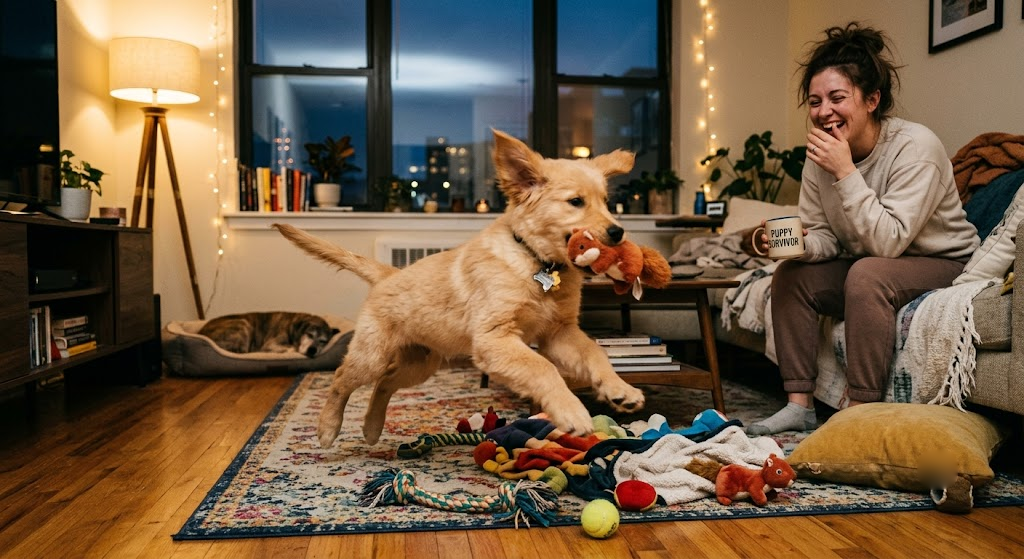
It's 6:45 pm. You've just sat down with dinner. And that's precisely the moment your sweet, sleepy morning puppy turns into a snarling, zooming, ankle biting tornado with dilated pupils and absolutely zero interest in your dinner, your ankles, or your sanity.
Welcome to puppy witching hour, the evening ritual that makes new puppy owners question every decision that led them to this couch, at this hour, covered in tiny bite marks.
Here's the good news before we go any further: this is not a training failure on your part, and it's not a sign of a "bad" puppy. It's a real, well documented behavioral pattern with actual biological reasons behind it, and there are concrete ways to shorten it, soften it, and eventually make it disappear almost entirely.
This guide walks through what's actually happening in your puppy's brain and body during the evening witching hour, why it hits so hard right when you're exhausted too, and the specific, practical strategies trainers and vets recommend for surviving it night after night.
What Exactly Is Puppy Witching Hour?
"Witching hour" isn't an official veterinary term, it's the nickname owners and trainers gave to a very specific window of evening chaos. It probably starts from anywhere around 6pm and doesn't end until your puppy completely crashes, and it's known as the witching hour, where your puppy turns completely and utterly wild.
Some puppies get their burst closer to dusk, others earlier. Anyone who's raised a puppy knows there's a certain time of day when their behavior goes from playful to pure chaos, that maddening stretch from 5 to 8 p.m. when your sweet little furball transforms into a biting, zooming whirlwind of energy.
During this window you'll typically see a mix of behaviors that seem to switch on like a light. This includes zoomies, nipping and biting, pulling on clothes with play growls, stealing objects, hyperactivity, chewing, and barking.
It genuinely can feel like living with two different animals. He would play lovely all day, with a walk and a bit of training and naps in between, then a certain time would roll around and it was like Dr Jekyll and Hyde.
It's Not Just Evenings, Either
While the evening version is the one that wrecks the most dinners, mornings can bring their own smaller episode. According to the National Canine Research Association of America, the witching hour is when your pup acts a bit wild and typically occurs early in the morning or between 5 and 8 pm.
Typically, puppies have two main active periods, in the morning and in the late afternoon or early evening. That's simply how young dogs are wired, and it lines up with a natural instinct we'll get into next.
Why Does It Happen? The Real Science Behind Evening Zoomies
There isn't one single cause, but a handful of overlapping factors that all tend to peak at the same time of day. Understanding them makes the behavior far easier to manage.
1. Dogs Are Crepuscular by Nature
This is probably the single most useful fact in this entire article, because it explains why the timing feels so relentlessly consistent. Dogs are crepuscular, meaning they are most alert at dawn and nightfall.
That biological rhythm doesn't disappear just because your puppy now lives on your sofa instead of in a den. Dogs are more alert and ready for action at that time, in stark contrast to humans, most of whom want to rest in the evenings, which makes the witching hour particularly difficult to manage because it happens at our most short tempered hours, when we just want food and sleep. In other words, your puppy isn't misbehaving on purpose at the worst possible moment. Biologically, nightfall is genuinely his moment to shine, right as you're trying to wind down.
2. A Full Day of Bottled Up Energy Finally Releases
Most puppies spend a chunk of the day snoozing while their owners work, run errands, or handle the school run. Many dogs rest during the day while their owners are busy, and by evening, that energy builds up and releases all at once.
Add in genuine excitement about everyone finally being home together, and you've got a recipe for an energy explosion. Puppies have boundless energy reserves, and if they haven't had enough physical and mental stimulation during the day, that energy will manifest itself in the form of late night zoomies.
3. Overtiredness Makes Everything Worse
This one surprises a lot of new owners, because it seems counterintuitive. Shouldn't a tired puppy just sleep?
Not quite. An overtired dog makes poor decisions, and an overtired puppy makes terrible decisions. If your puppy hasn't slept properly throughout the day, you can put money on experiencing the witching hour, because when puppies are overtired, they're restless, irritable and frankly quite annoying.
Think of it as the puppy version of the toddler who skipped their nap and is now bouncing off the walls at a birthday party. The tiredness itself becomes fuel for the frenzy rather than a cure for it.
4. Puppies Simply Can't Regulate Their Own Emotions Yet
A grown dog has learned, through months or years of practice, how to bring itself down from a state of high excitement. A ten week old puppy has none of that skill yet.
Puppies are terrible at regulating their own feelings, and the result of pent up energy usually comes out in the form of witching hour behaviours. This is a developmental stage, not a character flaw, and it genuinely does improve with age and guidance.
5. Overstimulation From the Day's Events
New visitors, a trip to a new park, changes in routine, even a shift in weather can all tip a puppy over the edge come evening. Environmental factors can also play a significant role, as new people, new surroundings, or even changes in the weather can overstimulate your puppy, causing them to act out in the evening.
How Long Does It Actually Last?
There's no universal answer here, and that's honestly one of the more frustrating parts of the whole phase. A few seconds, a few minutes, or an hour, you just don't know how long one of these sessions can last, and how long your puppy's witching hour lasts will depend on your dog and how you both handle the behavior.
The reassuring part is that it's rarely permanent. For most puppies, the witching hour phase starts to reduce by the time they reach 6 to 9 months of age, but it can pop up occasionally during adolescence.
Signs You're Watching Witching Hour (Not Something Else)
Most of the time this behavior is completely normal and nothing to worry about. Here's what typically shows up:
- Sudden bursts of running, spinning, or racing laps around furniture
- Intense nipping or "shark mouth" biting, especially at ankles, hands, and trouser hems
- Grabbing and shaking toys, cushions, or socks
- Barking or whining that seems to come from nowhere
- Ignoring cues your puppy usually responds to just fine
- Occasional house training accidents even after a clean day
Physically, you might also notice a puffed out look during the zoomies, along with dilated pupils, panting, and a raised tail. These are simply signs of high arousal, not distress.
When It's Worth a Call to the Vet or Trainer
Witching hour on its own is harmless in the vast majority of cases. The dog witching hour is usually harmless, but it's worth consulting a vet or trainer if your dog shows other concerning signs alongside it.
Repetitive circling deserves a closer look too, rather than being dismissed as ordinary zoomies. Regular, compulsive spinning can indicate a neurological issue, and it's a good idea to make an appointment with your vet. A one off lap around the living room is nothing to worry about; daily, obsessive spinning in tight circles is a different story.
Surviving Puppy Witching Hour: A Practical Evening Plan
Here's where we get into what actually helps. None of this eliminates puppyhood overnight, but each piece chips away at the intensity and length of the evening spiral.
1. Front Load Physical Exercise Earlier in the Day
Don't save the big walk for right before dinner, hoping to tire your puppy out. That timing often backfires and adds fuel to an already building fire. Get into a regular exercise routine and schedule it consistently, so your dog can release energy that way instead of through an evening explosion.
A short, structured walk plus some sniffing time in the late afternoon, well before the usual witching hour start time, gives that energy somewhere to go before it peaks.
2. Protect Daytime Naps Like They're Sacred
This is the piece most new owners underestimate. If puppies haven't had enough nap time during the day, they can become overtired, overstimulated and cranky, leading to the puppy witching hour.
Puppies need an enormous amount of sleep, often 18 to 20 hours a day when very young. If your household is loud, busy, or full of visitors all day, your puppy may simply never get a proper deep sleep cycle in, and evenings pay the price for it.
3. Build a Predictable Daily Rhythm
Structure is genuinely one of the most effective long term fixes here. Like a human child, puppies thrive on predictability and consistency, and a daily schedule that includes regular feeding times, potty breaks, playtime, and nap times helps achieve that.
When a puppy can more or less predict what happens next, arousal spikes tend to smooth out over the following weeks.
4. Have "Legal" Chew Options Ready Before the Storm Hits
Don't wait until teeth are already on your sleeve to go looking for a toy. Set things up in advance.
Keep a few high value bones or toys handy so your puppy has something else to do when he gets bitey, and rotate a new one in once he gets bored of the current one. Frozen options work particularly well because they slow the puppy down and require sustained focus.
Frozen Kongs are a life saver, especially with something tasty inside such as peanut butter, squeeze cheese, or wet canned puppy food. Chewing itself has a genuinely calming physiological effect, not just a distracting one.
5. Redirect Biting Immediately and Consistently
Hands are not chew toys, full stop, and letting that slide even occasionally sends a confusing message. Your hands are not chew toys, so don't let them become one; when your puppy starts biting, offer a different bone if necessary, and keep redirecting them onto it, over and over again.
Consistency matters far more than any single clever trick here. Every family member needs to use the same redirection approach, or the puppy simply learns that biting works on some people and not others.
6. Use Sniffing and Scent Games to Bring Arousal Down
This is a genuinely underused tool, and it deserves more attention than it usually gets. Scattering kibble or treats in the grass or around the living room works because sniffing lowers arousal and is a really good way to let dogs decompress, channelling their energy into something that naturally soothes them.
Compare this to more zoomies or more fetch, which can sometimes crank arousal up rather than down. If your dog is already in full chaos mode, the fastest way to calm them isn't more exercise, it's mental stimulation.
7. Teach a Genuine "Off Switch" Cue
Beyond managing individual episodes, you can actively train calmness as a skill. Teaching basic commands like sit, down, stay, and drop it can help you redirect behavior during the puppy witching hour and encourage impulse control.
Practice these cues during calm moments earlier in the day, not for the first time in the middle of a frenzy. That way, by the time evening chaos hits, the behavior is already familiar rather than brand new.
8. Reward Calm the Moment You See It
It's tempting to just breathe a sigh of relief when the madness finally stops and get back to your evening. Don't skip the follow up step. As your puppy acts peaceful, reward this behavior so that it learns what is suitable.
A quiet word, a gentle scratch, or a small treat when your puppy settles reinforces exactly the behavior you're hoping to see more of tomorrow.
9. Set Up a Safe Space for Timeouts
Sometimes the kindest and most effective move isn't more engagement, it's a break. You may have to encourage your puppy to settle by placing some tasty treats in their crate, if your pup uses one, or giving them a chew in their pen, to encourage downtime.
A pen or crate with a stuffed chew toy isn't a punishment here, it's a decompression zone, and most puppies learn to genuinely appreciate having one.
10. Manage the Environment, Not Just the Puppy
If zoomies are happening indoors, footing matters more than people expect. If a zoomie kicks off indoors on slippery floors, moving them to somewhere with carpeted floors gives the dog secure footing, and taking them outside is even better to prevent running into furniture or walls.
This is especially important with larger breeds or households with small children underfoot.
Managing Witching Hour With Kids in the House
If you've got children at home, the timing can feel like a cruel coincidence. If you have kids, you've probably noticed they have a witching hour too, and combining that with a hyper puppy creates a recipe for mayhem.
Consider staggering things where possible. Feed and settle younger kids slightly before or after the puppy's usual peak window, and keep interactions calm and supervised rather than letting excited children amp the puppy up further during an already high arousal period.
Feeding Timing Can Genuinely Help Too
Hunger is an easy thing to overlook when you're troubleshooting behavior. Sometimes a bitey puppy is just a hangry puppy, and a satisfied belly often leads to a calmer pup.
Shifting dinner slightly earlier, or splitting it so a portion arrives right around when the witching hour typically starts, can genuinely soften the intensity of the episode for some puppies.
Will Puppy Witching Hour Ever Actually End?
Yes, for the vast majority of dogs, it does fade. Adult dogs might have fewer and infrequent witching hours, which are generally caused by being overstimulated or understimulated.
That said, some breeds hold onto higher baseline energy needs well into adulthood. Certain breeds simply have complex activity levels, and these breeds may suffer from witching hours if not given adequate daily stimulus, even as adults.
Every puppy's timeline looks a little different, and that's genuinely fine. Your pet is an individual, and it's impossible to forecast exactly when your puppy will start relaxing faster because every puppy is different. What matters is that the trend, month over month, moves in the right direction with consistent management.
Conclusion
Puppy witching hour is loud, exhausting, and often happens at the exact hour you have the least patience left to give. But it's not a sign that something has gone wrong with your training, and it's certainly not permanent.
The core fixes are refreshingly unglamorous: move exercise earlier in the day, protect real nap time, build a predictable routine, keep chew toys loaded and ready, and reward calm the second you see it. Sniffing games and a proper off switch cue do more heavy lifting than most people expect.
Give it a few weeks of consistent handling and you'll likely notice the storm shrinking, both in intensity and in length, well before your puppy reaches adolescence. Hang in there. This phase, chaotic as it feels tonight, really does pass.
Frequently Asked Questions
What time does puppy witching hour usually start?
Most owners report it kicking in somewhere between 5 pm and 9 pm, though the exact window varies by puppy. Some also see a smaller version early in the morning, since dogs are naturally more alert at dawn and dusk.
Is puppy witching hour the same as zoomies?
Zoomies, or sudden bursts of frantic running, are one common feature of witching hour, but the full episode often includes extra biting, barking, and ignoring cues on top of the running. Witching hour is really the whole package of evening hyperactivity, not just the running part.
At what age does puppy witching hour stop?
Many puppies see it noticeably fade between six and nine months old as they mature and get better at self regulating their emotions. Some higher energy breeds may still show occasional flare ups into adolescence if their daily needs aren't fully met.
Should I ignore my puppy during witching hour?
Ignoring outright rarely works well, since an overtired, overstimulated puppy usually needs redirection rather than isolation. A better approach is calmly offering an appropriate chew toy or a short decompression break in a pen or crate, then rewarding the moment they settle.
Does more exercise always fix witching hour?
Not necessarily, and this surprises a lot of owners. An overtired puppy often gets worse, not better, so the goal is well timed exercise earlier in the day combined with genuine daytime naps, plus calming mental stimulation like sniffing games in the evening itself.
Is it normal for my puppy to bite hard during witching hour?
Yes, increased nipping and mouthing is one of the most common witching hour behaviors, largely tied to teething and excess arousal. Consistent redirection onto chew toys, rather than occasional tolerance of hands as chew targets, tends to reduce this fastest.
More Articles
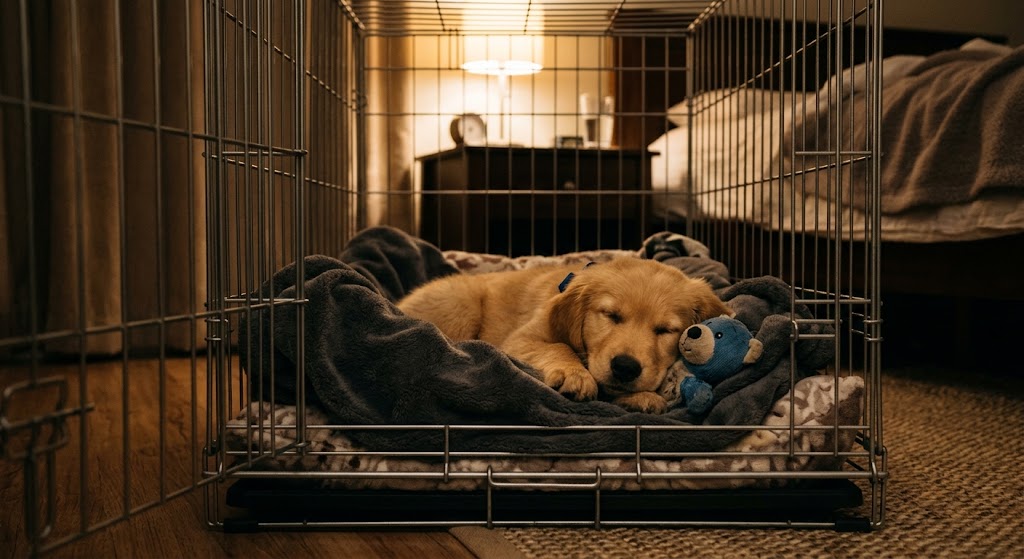
What to Do on the First Night With a New Puppy
Your first night with a new puppy doesn't have to be stressful. Get our real-world tips for a calmer night and easier bonding from day one.
Read more →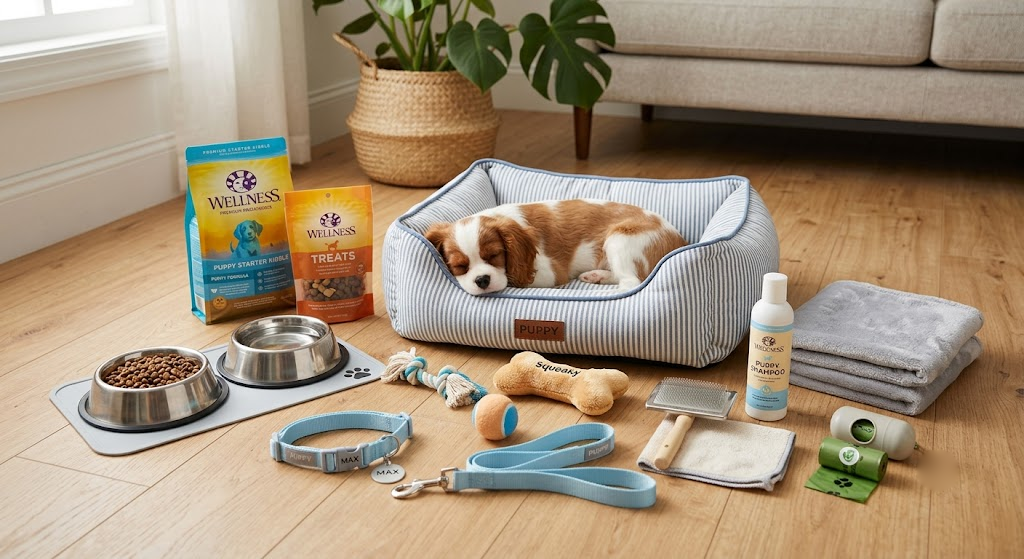
Puppy Starter Kit: Everything You Need for Under One Hundred
Complete puppy starter kit for under $100. See exactly what to buy, what to skip, and where to save on essential new puppy supplies.
Read more →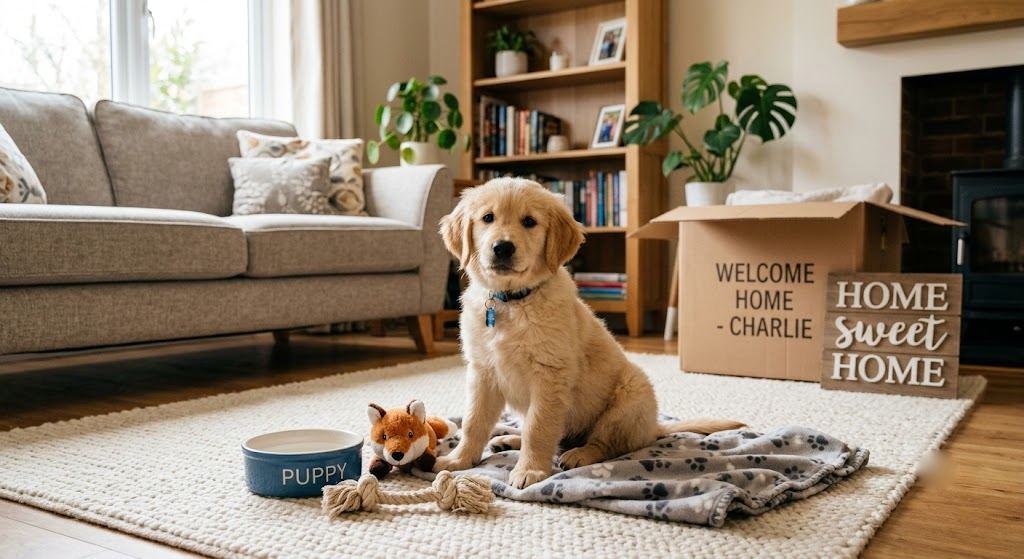
How Long Does It Take a Puppy to Settle Into a New Home
How long does it take a puppy to settle into a new home? Get real timelines, signs of progress, and tips to help your pup adjust faster.
Read more →