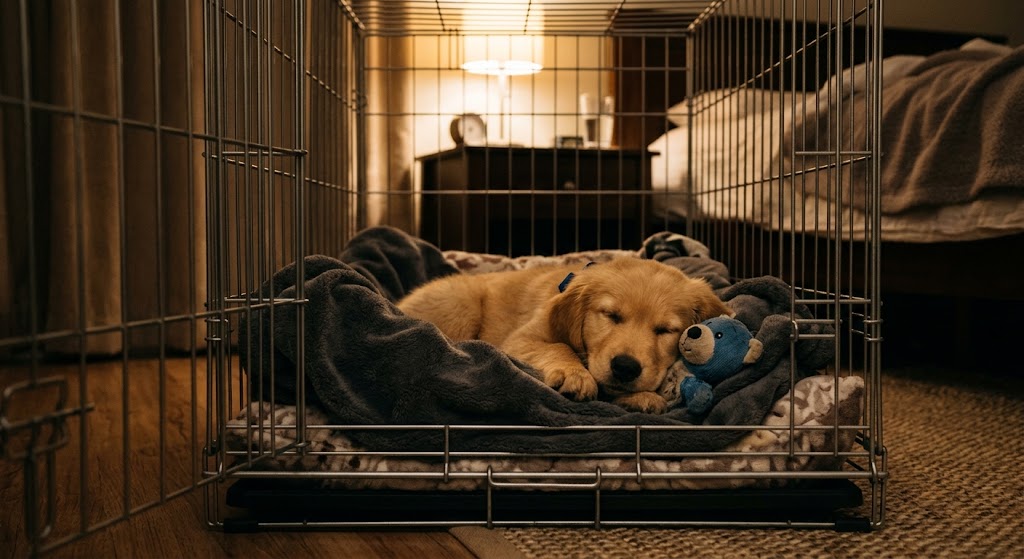
That first night home, everyone pictures a Norman Rockwell painting. Warm porch light, puppy curled up in a basket, everybody asleep by ten. Then reality shows up around 2 a.m., and it sounds less like a painting and more like a smoke alarm with lungs.
Here's the actual answer to what you should do: set up a sleep space close to you, keep the lights low and the energy lower, plan for at least one or two potty breaks, and expect some crying that you will not ignore. That's the whole skeleton of it. Everything else is just filling in the details so you're not improvising at midnight with a confused, homesick pup staring up at you like you hold the answers to the universe. You kind of do, actually. That's the job now.
What Should You Do Before Your Puppy's First Night Home?
You do the boring stuff before the cute stuff. I know, nobody wants to think about baby gates when there's a fluffball in the car on the way home, but prep work is what makes the first night survivable instead of chaotic.
Buy supplies in advance
Get the crate, the bed, the bowls, a collar and leash, and a bag of the same food your breeder or shelter was already feeding, before your puppy ever crosses the threshold. Switching food cold turkey on day one is asking for a stomach upset at 3 a.m., and nobody wants that kind of surprise. According to the AKC's puppy essentials guide from their insurance division, having these basics sorted ahead of time also means you're not scrambling to a pet store with a screaming puppy in the passenger seat, which, trust me, is its own kind of chaos.
Puppy-proof the house
Get on your hands and knees. Actually do it. Puppy eye level reveals things you'd never notice standing up, phone chargers, loose socks, the corner of a rug that's just begging to be chewed. Check for anything toxic too. Xylitol, certain houseplants, fabric softener sheets left on the floor, they're all quietly dangerous, and Veterinary Partner's rundown on household hazards is worth a slow read before you bring anyone home. Baby gates across doorways aren't overkill either. They're the difference between a contained mess and a puppy loose in the kitchen trash at midnight.
Set up a safe sleep space
Pick one spot. Not the sofa, not "we'll figure it out." A defined, safe space with a crate or pen, away from drafts, away from stairs, close enough to hear if something's wrong. This becomes the anchor point for the whole night, and honestly, the whole first week.
Where Should Your Puppy Sleep the First Night?
This is the question every new owner obsesses over, and for good reason, because get it wrong and you're in for a long, loud few nights.
Place the crate near your bed
The American Animal Hospital Association points to something pretty simple here: puppies just left their littermates and their mother, and suddenly they're alone in a giant, echoey house. Put the crate right next to your bed, close enough that your pup can hear you breathing, maybe even smell you. That proximity does more for calming a puppy down than any toy or blanket ever could.
Add familiar scents and warmth
Ask the breeder or shelter for a blanket that smells like the litter before you leave. That scent does something almost magical for a stressed pup. Pair it with a low, soft light and maybe a ticking clock or white noise machine, since the rhythmic sound can mimic a mother's heartbeat, and you've built a space that feels less like exile and more like home.
How Do You Build a Calming Bedtime Routine?
Routine is the whole game here. Not charm, not luck, just repetition.
Schedule play before bedtime
A short burst of play, maybe fifteen minutes of tug or a little fetch down the hallway, burns off that last bit of puppy energy. Follow it with a calm stretch, some quiet petting, and you're signaling that the fun is winding down without anyone feeling punished for it.
Stick to a feeding schedule
Feed dinner a few hours before lights out. The Blue Ridge Humane Society recommends roughly three hours between the last meal and bedtime, which gives digestion time to do its thing before anyone's tucked into the crate. Feed too close to bedtime and you're basically guaranteeing a middle-of-the-night potty emergency.
Wind down with a consistent bedtime script
Drink, potty, quick tumble with a toy, a few minutes of quiet cuddle, then into the crate with the same phrase every night, something like "bedtime" or "kennel up." Puppies latch onto patterns fast. Do this same sequence for a week straight and you'll notice the whining start to fade, because the script itself becomes the comfort.
How Often Should a Puppy Go Out at Night?
Nobody sleeps eight hours straight the first night. Set that expectation now so you're not blindsided.
Expect frequent potty breaks
The general rule, according to the Animal Humane Society's crate training guide, is a puppy's age in months plus one equals roughly how many hours they can hold their bladder. A two-month-old pup, then, is looking at about three hours max. That means you're waking up, more than once, whether you like it or not.
Keep nighttime trips quiet and boring
This is where a lot of new owners mess up without meaning to. They turn the potty break into playtime, chatting, cooing, maybe a little wrestling on the lawn. Don't. Purina's guidance on the first week home is blunt about this: keep it dark, keep it quiet, straight outside, straight back to the crate. You're teaching a puppy that nighttime means sleep, not a party, and that lesson sticks a lot faster if you're boring about it on purpose.
Watch for signs your puppy needs to go
Circling, sniffing at the crate corner, sudden restlessness after being still, these are the tells. A short, sharp whine that's different from the settling-in cries usually means business, and ignoring it just means cleaning up a mess in the morning.
Why Is Your Puppy Crying, and What Should You Do?
Almost every puppy cries the first night. It would honestly be a little strange if they didn't.
Understand why puppies cry the first night
Think about what just happened to this animal. Days ago, they were pressed up against littermates and their mother, warm bodies everywhere, familiar smells. Now they're alone in a plastic crate in a house that creaks in ways they've never heard. Crying isn't drama. It's a survival instinct kicking in, a call for the pack that isn't there anymore.
Comfort your puppy instead of ignoring them
The old-school advice was to let them cry it out, same as some people do with human infants. Modern veterinary guidance pushes back hard on that. PetMD's veterinary team advises against letting a very young puppy cry unattended, because at this age you're not spoiling anyone, you're building trust. A hand resting on the crate, a low voice, maybe a knuckle through the bars, that's enough most nights to settle things down without pulling the puppy out and undoing your crate training progress.
Know when crying signals a real need
Not all crying is the same. Sometimes it's an actual bathroom emergency dressed up as anxiety. Chewy's first night guide suggests checking for the obvious first, does the puppy need to go out, is the crate too warm or too cold, before assuming it's pure separation stress. A quick check costs you two minutes. Guessing wrong costs you a load of laundry.
How Do You Bond With Your Puppy on Night One?
Bonding on night one isn't about big gestures. It's small, repeated moments, a hand on the fur while they settle, your voice low and steady during a potty break, sitting near the crate for a few minutes instead of walking off the second the lights go out. Puppies read presence, not effort. You don't need to entertain them into loving you. You just need to be there, consistently, so they start filing you under "safe" instead of "unknown."
What Are Common First-Night Mistakes to Avoid?
A few habits sink more first nights than anything else:
- Letting the puppy sleep on the sofa or in bed with you "just this once," then wondering why that becomes the expectation every night after.
- Skipping the last potty break because everyone's tired and just wants to go to sleep already.
- Turning nighttime potty runs into playtime with lights, chatter, and toys.
- Moving the crate to a new room the following night after starting somewhere else, which resets the sense of safety you just built.
- Feeding too late or giving too much water right before bed, setting up a bladder problem nobody wants to deal with at 1 a.m.
When Does a Puppy Start Sleeping Through the Night?
Most pups start sleeping through, or close to it, somewhere around three to four months old, according to Chewy's guide on nighttime sleep training, especially once they're getting the full 18 to 20 hours of daily sleep that young puppies actually need. That's an average, not a promise. Bigger breeds, smaller bladders, individual temperament, it all shifts the timeline a bit in either direction. The pattern matters more than the exact date. Fewer wake-ups, shorter potty breaks, less crying, that's the trajectory you're looking for, and if it's not moving that direction by four or five months, a chat with your vet isn't a bad idea.
FAQ
Should I let my puppy sleep in bed with me the first night? Most trainers and vets advise against it,
mainly because whatever happens night one tends to become the standard. Keep the crate close by instead.
How many times will my puppy need to go out during the night? Expect at least one or two trips for a young puppy, sometimes more depending on age and bladder size.
Is it normal for a puppy to bark or whine most of the night? Yes, especially the first couple of nights. It should taper off within a few days as routine sets in.
Should I use a nightlight or leave the room dark? A very dim light is fine and can actually help a nervous pup see their surroundings without overstimulating them.
Conclusion
The first night is rarely the peaceful scene anyone imagines, and that's fine. It's supposed to be a little messy. What matters is that you showed up, kept the crate close, answered the crying instead of burying your head under a pillow, and started building a routine your pup can actually count on. Do that consistently, and within a week or two, the sofa gets quieter, the crying fades, and what's left is a dog who trusts you. That trust, more than any perfectly executed schedule, is the whole point of night one.