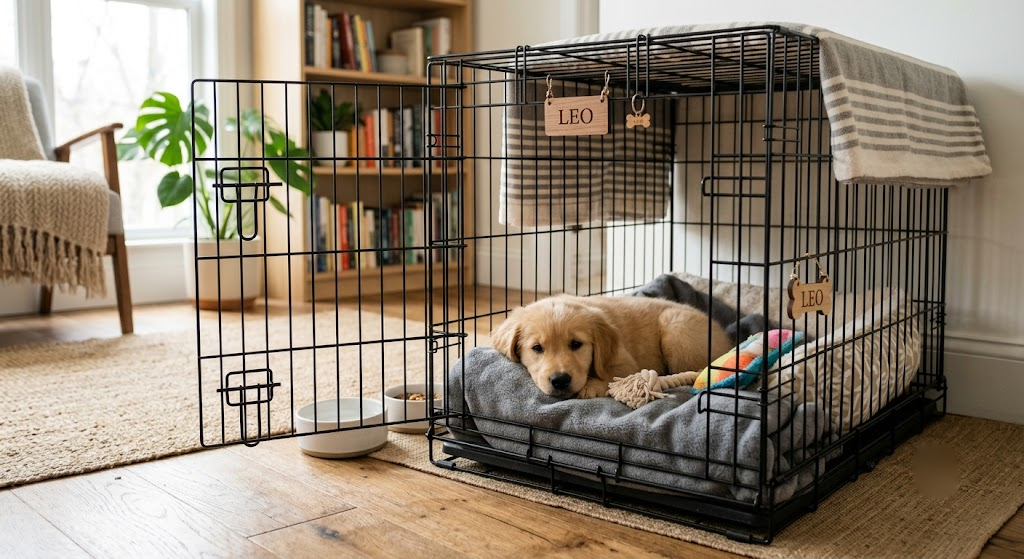
My neighbor got an Alaskan Klee Kai puppy last spring, one of those small, sharp-eyed spitz breeds that look like a wolf shrunk down to fit an apartment, and within two weeks she'd bought three different crates because none of them fit right. The first was too big, the pup peed in one corner and slept in the other. The second one, a flimsy wire thing, got bent at the seams within a month because Klee Kai dogs are notorious chewers and diggers when they're bored or anxious. Third time was the charm. That's the real story behind buying a crate. It's rarely a one-shot decision, and there isn't a single "best" crate that works for every dog.
So here's the direct answer, since you probably don't want to read six paragraphs before getting one: for most puppies, a wire crate with a divider panel, like the MidWest iCrate, is the smartest starting point because it grows with your dog and won't wreck your budget. But that answer changes fast depending on breed, chewing habits, anxiety levels, and whether you're crating at home or hauling your dog across state lines in a truck bed. Let's get into why.
How Do You Choose the Right Crate Size for Your Puppy?
Sizing a crate wrong is probably the single most common mistake new puppy owners make, and it's not even close. Too much room and your pup treats one end as a bathroom, defeating the entire purpose of den training. Too little room and you've got a stressed, cramped dog who dreads going in.
Measure Your Puppy Correctly
Grab a tape measure before you grab your wallet. The rule most trainers and vets repeat, including guidance from the American Kennel Club on crate sizing, is that a dog crate should let your puppy stand up fully, turn around without twisting sideways, and lie down with legs stretched out, nothing more. Measure nose to base of tail, then shoulder to ground, and add a few inches to each figure. PetMD's formula gets specific here, recommending 2 to 4 inches of clearance in both length and height so the crate feels secure without feeling like a shipping container.
Account for Adult Breed Size
Here's where people mess up twice. They buy a crate that fits the eight-week-old puppy in front of them and completely ignore what that puppy becomes at fourteen months. A Great Pyrenees puppy and an Alaskan Klee Kai puppy might look like similar-sized fluffballs at nine weeks, but one ends up 100 pounds and the other tops out around 20. The CareCredit veterinary network's sizing guide walks through this exact miscalculation and pushes owners to research adult breed weight and shoulder height before ever clicking "buy."
Use Divider Panels for Growing Puppies
This is the fix for the sizing headache, and it's not complicated. Buy the crate sized for your dog's adult frame, then use an adjustable divider panel to shrink the usable space while they're small. As the puppy grows, you slide the panel back. The AKC's own step-by-step training breakdown recommends this exact approach, and it's basically why the MidWest iCrate remains a go-to recommendation among trainers, since it ships with a divider built in rather than sold separately.
What Are the Main Types of Puppy Crates?
Not all crates are built for the same job, and conflating them is where owners waste money.
Wire Crates
Wire crates dominate the home-training market for good reason. They're breathable, collapsible for storage, and let your dog see the room instead of feeling boxed in, which matters a lot for social breeds that get anxious when isolated. Cornell's Riney Canine Health Center breaks down the material tradeoffs pretty well, noting wire structures offer superior airflow but less insulation and less durability against a determined chewer.
Plastic and Travel Crates
Plastic crates, sometimes called airline kennels, are enclosed, den-like, and typically required for actual air travel. They block visual stimulation, which sounds bad but actually calms certain anxious dogs who get overstimulated by an open wire design. Petmate's comparison framework on plastic versus metal notes that plastic holds up better in cold climates because there's less exposed metal, though ventilation suffers in humid regions.
Soft-Sided and Furniture-Style Crates
Soft-sided crates and furniture-style crates that double as end tables are having a moment, especially among renters who don't want a wire cage dominating the living room. They're lightweight, decent for travel carriers when your dog is already crate-trained and calm, but they're a bad match for a teething puppy. One Reddit thread of dog owners swapping crate suggestions makes this point bluntly: soft fabric doesn't survive a determined chewer, full stop.
Which Puppy Crates Are Worth Buying?
Crate | Best For | Approx. Price | Standout Feature |
|---|---|---|---|
MidWest iCrate | Best overall, growing puppies | $40-$110 | Includes divider panel |
Diggs Revol | Premium home use | $200-$300+ | Collapsible, modern design |
EliteField 3-Door Soft Crate | Travel, trained dogs | $50-$90 | Lightweight, portable |
Gunner G1 Kennel | High anxiety dogs, chewers | $300-$500+ | Crash-tested, near indestructible |
Impact Collapsible Crate | Working and anxious dogs | $250-$450 | Aluminum frame, foldable |
Best Overall: MidWest iCrate
Reviewers keep landing back on the MidWest iCrate for a reason. It's affordable, it includes that growth divider, and it's been the default recommendation across nearly every major pet publication for years. This is the crate I'd point a first-time puppy owner toward without much hesitation.
Best Premium Pick: Diggs Revol
The Diggs Revol crate costs considerably more, but it folds flat like a laptop, has rounded edges so nobody bangs a hip on sharp metal, and just looks less like a cage sitting in your living room. The Spruce Pets' testing team highlighted it as a top pick for owners who want the collapsible convenience without sacrificing aesthetics, though they're upfront that the price tag is steep compared to a basic wire crate.
Best for Travel: EliteField 3-Door Soft Crate
For dogs who are already through the chewing phase and need something light to toss in the backseat for a road trip or vet visits, the EliteField holds up fine. Just don't expect it to survive an anxious puppy left alone for the first time.
How Much Should You Spend on a Puppy Crate?
Budget Crates Under $50
You can absolutely get a functional basic wire crate under $50, and for most puppies that's plenty. Skip the frills, focus on solid latches and a divider panel if the size allows.
Mid-Range Crates $50 to $150
This range covers most quality MidWest crates, some plastic airline kennels, and better-built soft-sided options. It's the sweet spot for most households.
Premium Crates Over $150
Once you're past $150, you're paying for design, like the Revol, or paying for near-indestructible strength, like the Gunner G1 Kennel or an Impact Collapsible Crate favored by owners of high-energy working breeds or genuinely anxious dogs who've broken cheaper kennels before.
How Do You Use a Crate for House-Training?
Introduce the Crate Gradually
Don't just shove a puppy in and shut the door. The Animal Humane Society's conditioning protocol recommends starting with meals placed inside the crate, door open, letting the dog wander in and out on its own schedule for several days before you ever latch anything shut.
Follow a Consistent Schedule
Potty training lives and dies by consistency. Take the puppy out first thing in the morning, right after meals, after play, and right before bed, every single time, without exception, for at least a few weeks straight.
Avoid Common Crate-Training Mistakes
- Using the crate as punishment, which teaches the dog to fear the one place meant to feel safe
- Leaving a puppy in far longer than its bladder can handle, which forces accidents and undoes housebreaking progress
- Skipping the gradual door-closing step outlined by Humane World's crate training fundamentals, which recommends short, low-pressure intervals before working up to longer stretches
How Do You Handle Crate Anxiety or Escape Attempts?
Some dogs, and Klee Kai dogs are frequently named among them by owners online, panic in confinement and will bend wire, chew through plastic latches, or bloody their paws trying to escape. This is where an impact high anxiety crate earns its keep. Brands building aluminum impact collapsible dog crate models market specifically toward dogs with a documented history of destroying standard kennels. SPCA Tampa Bay's confinement guidance is blunt about it too: never force a panicking dog deeper into the crate, back off, and rebuild trust slowly instead.
What Accessories Make a Crate More Comfortable?
A bare wire floor isn't comfortable for anyone. Add a supportive crate mat or pad sized to the interior floor, something chew-resistant if your dog is a shredder. A water bowl clipped to the door prevents spills. For dogs with real separation anxiety, a worn t-shirt with your scent tucked into a corner does more good than any gadget on the market.
Is a Plastic or Metal Crate Better for Your Puppy?
It depends entirely on temperament and climate. Happy Pet HQ's breakdown of plastic versus wire notes plastic crates trap heat in warmer regions but insulate better in cold ones, while wire crates ventilate well but offer zero visual privacy, which can actually agitate an already anxious dog rather than calm it.
How Big Should a Crate Be for an Adult Dog Later?
Go back to those breed weight charts. PetSmart's size and weight matrix maps out ranges from extra-small toy breeds through large working dogs, and it's worth checking against your specific breed's growth curve rather than guessing.
FAQ
Do puppies need a crate at night from day one? Yes, most trainers recommend starting immediately, using the divider to keep the space appropriately small.
Can two puppies share one crate? Generally no, separate crates prevent resource guarding and let you track each dog's house-training progress individually.
How long can a puppy stay crated during the day? Roughly one hour per month of age, plus one, is the commonly cited rule, though it's not a hard science.
Conclusion
There's no universal winner in the dog crate market, and anyone claiming otherwise is selling something. What matters is matching the crate to your dog's actual size, temperament, and chewing habits rather than what looked good in a five-star review. Measure carefully, size for the adult dog, and don't be afraid to spend more if your pup has already proven a cheaper kennel isn't going to hold.